
Do you need a license to show a movie outdoors? This question comes up constantly, usually right after someone’s already picked a movie and started planning. Short answer: probably yes. Here’s the longer version.
Owning the movie isn’t the same as the right to show it
A DVD, a Blu-ray, or a personal Netflix or Disney+ subscription gives you the right to watch at home. It doesn’t include the right to show that movie publicly, even if nobody’s paying to get in.
“Free admission” doesn’t change the answer
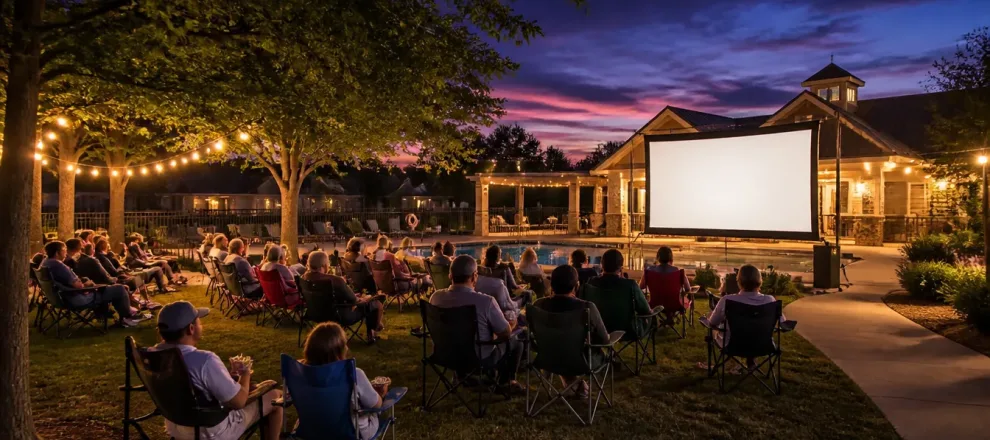
This is the part that trips people up most. Money changing hands isn’t the test. The law asks whether the showing is public: at a place open to the public, or wherever a substantial number of people outside a normal circle of family and social acquaintances gather (17 U.S.C. §101). An HOA common area, a school gym, a church parking lot, a company picnic: all of these usually count as public or semi-public, ticket or no ticket.
A private get-together? Different story
A small gathering of family and social acquaintances at home may not be a public showing at all, since the definition is built around that normal circle. The line gets blurry once you invite the whole neighborhood, post the event publicly, or the crowd grows well past your own circle. If you’re not sure which side you’re on, ask before you plan around it.
Are there any exemptions?
A few, and they’re narrow. One example is certain face-to-face classroom teaching at a nonprofit school. A school movie night, PTA fundraiser, or campus event is a different thing. Still unsure? Tell us about your event and we’ll help confirm what rights are needed.
Who actually enforces this?
Studios and their licensing partners do occasionally follow up on unlicensed public screenings, particularly ones advertised publicly (a flyer, a community Facebook post, a city parks calendar). It’s not a hypothetical risk — it’s a real, if usually low-profile, part of how studios protect the value of a theatrical release.
What it actually takes to get one
A handful of licensors handle non-theatrical public performance rights, and the process is usually just picking your title, confirming your audience size, and paying a licensing fee that varies by title and how many people are expected. It’s paperwork, not a barrier — most groups get it sorted in a few days once they know who to ask.
Not sure if your event needs one? Ask us. We can help point you in the right direction, or arrange it as part of your quote if that’s easier. This post is general information, not legal advice.